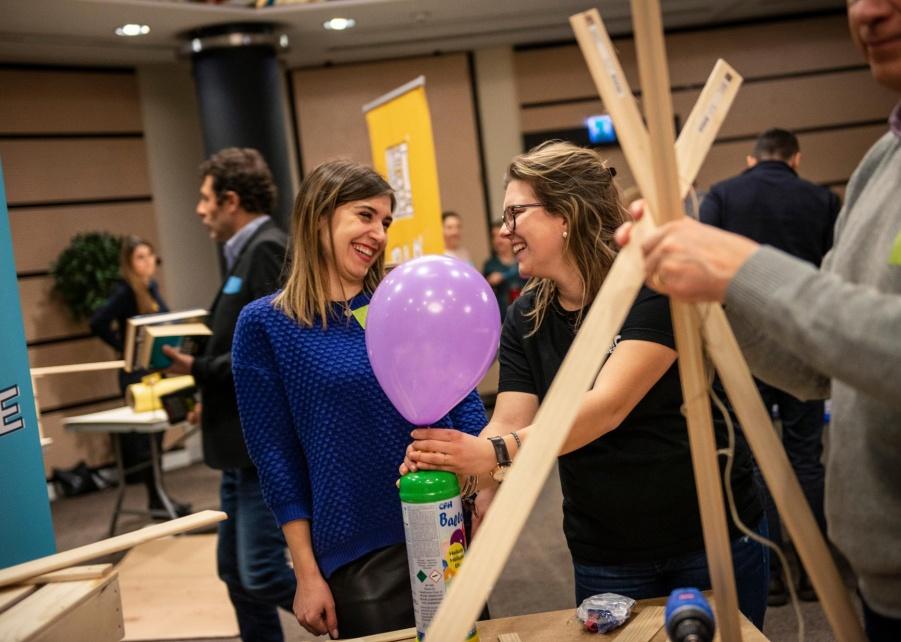
WHAT IS THE RUBE GOLDBERG MACHINE?
The Rube Goldberg Machine is a team building format in which groups design and build independent construction modules that are then connected into one chain reaction mechanism — and triggered as a single unified system during the Grand Finale.
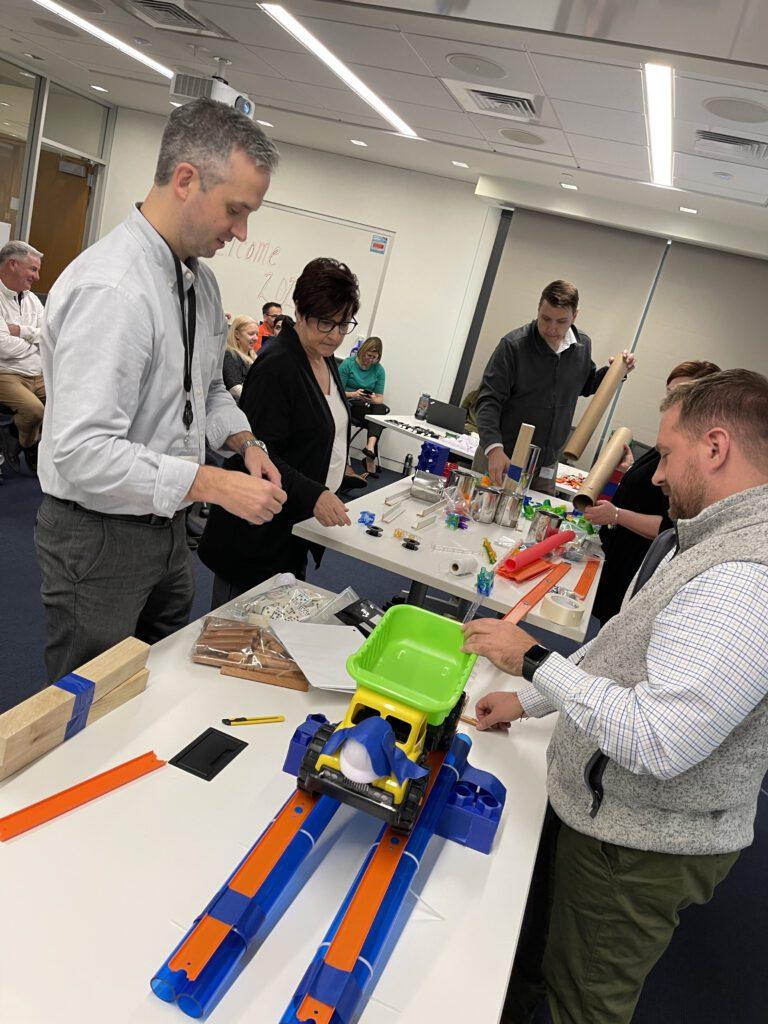
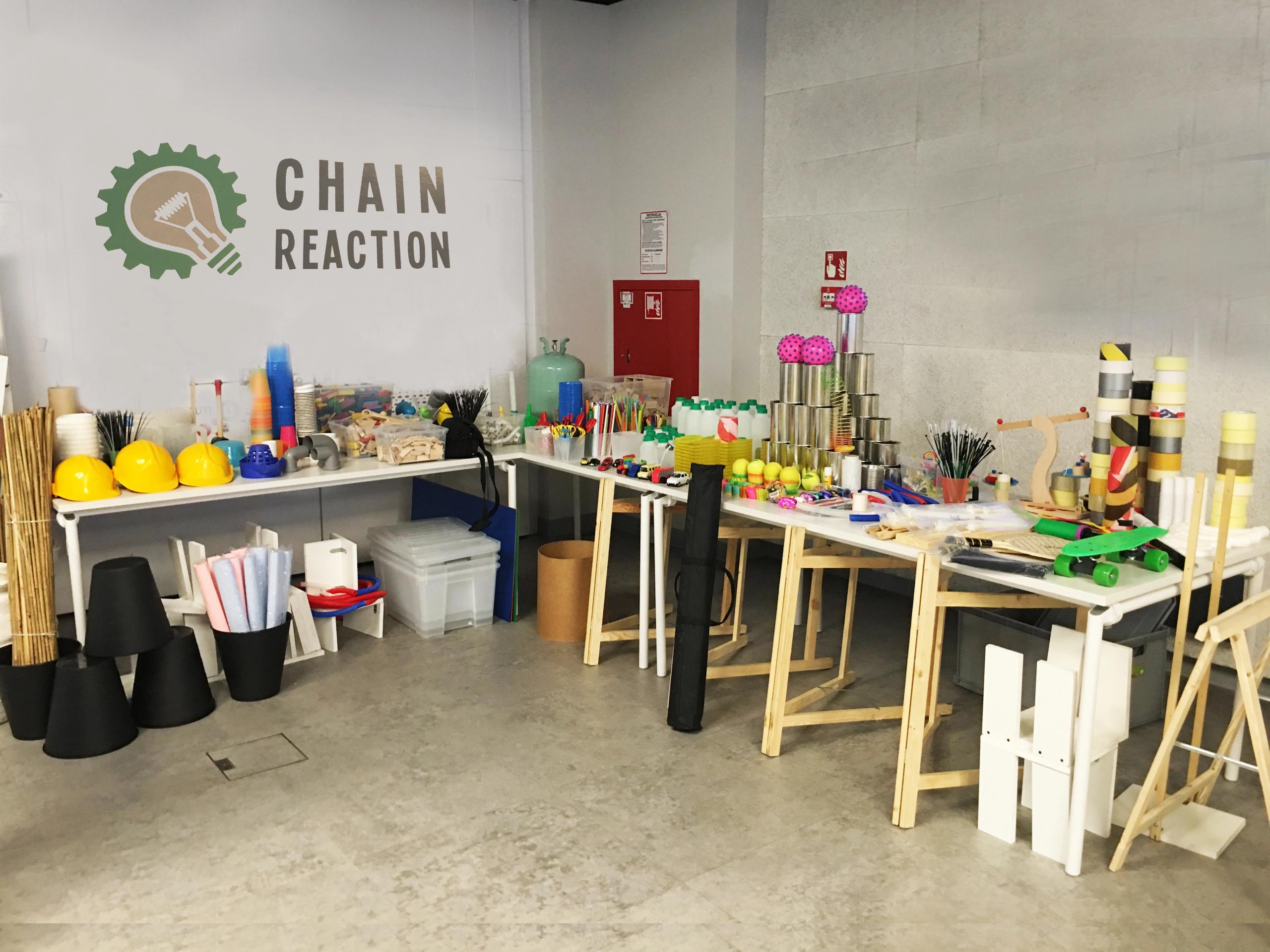
Participants are split into small construction teams. Each group receives an identical set of materials and one objective: design and build their section of the machine so that it receives an impulse from the previous module and reliably passes it on to the next. It sounds straightforward. In practice, it demands something that no internal process document can mandate — genuine coordination across teams.
Throughout the build, groups must continuously negotiate with their neighbours: what exactly leaves your module? At what speed? At what height? These aren't technical questions — they're the same questions your departments navigate every day when passing a project from one team to another.
The session culminates in the Grand Finale: the entire chain reaction is triggered from first module to last. The machine either works — or it pinpoints exactly where the weak link is.
What sets this format apart: Unlike most team building activities that pit groups against each other, the Rube Goldberg Machine requires every single team to succeed — or none of them do. That's a fundamentally different experience, and one that's far more relevant for organisations dealing with silo mentality and cross-departmental friction.
HOW DOES IT WORK?
- 1Briefing and team formation
Teams receive their materials and learn the rules. The key moment: groups discover their success depends entirely on the work of others — and that they'll need to coordinate this themselves, without a project manager in the room.
- 2Design and build
Each team works on their section of the machine. Different working styles, problem-solving approaches, and — most interesting from an HR perspective — very different communication strategies with neighbouring groups emerge naturally. Some teams work intuitively, others draft specifications. Our facilitators observe without interfering.
- 3Cross-module testing and coordination
The most tension-filled phase. Teams check whether their modules will be compatible with their neighbours'. Negotiations, compromises, and occasional conflicts arise. This is the most valuable stage from a team building perspective — and the richest in observable team behaviour.
- 4The Grand Finale
The entire machine is triggered from start to finish. The moment everyone has been waiting for. Silence, tension, the chain reaction — and a shared celebration when the mechanism fires perfectly.
- 5Debrief
A structured discussion: what worked? What was the hardest part? What does the team take back to the office? This stage can be extended into a facilitated conversation involving HR or a senior manager — on request.
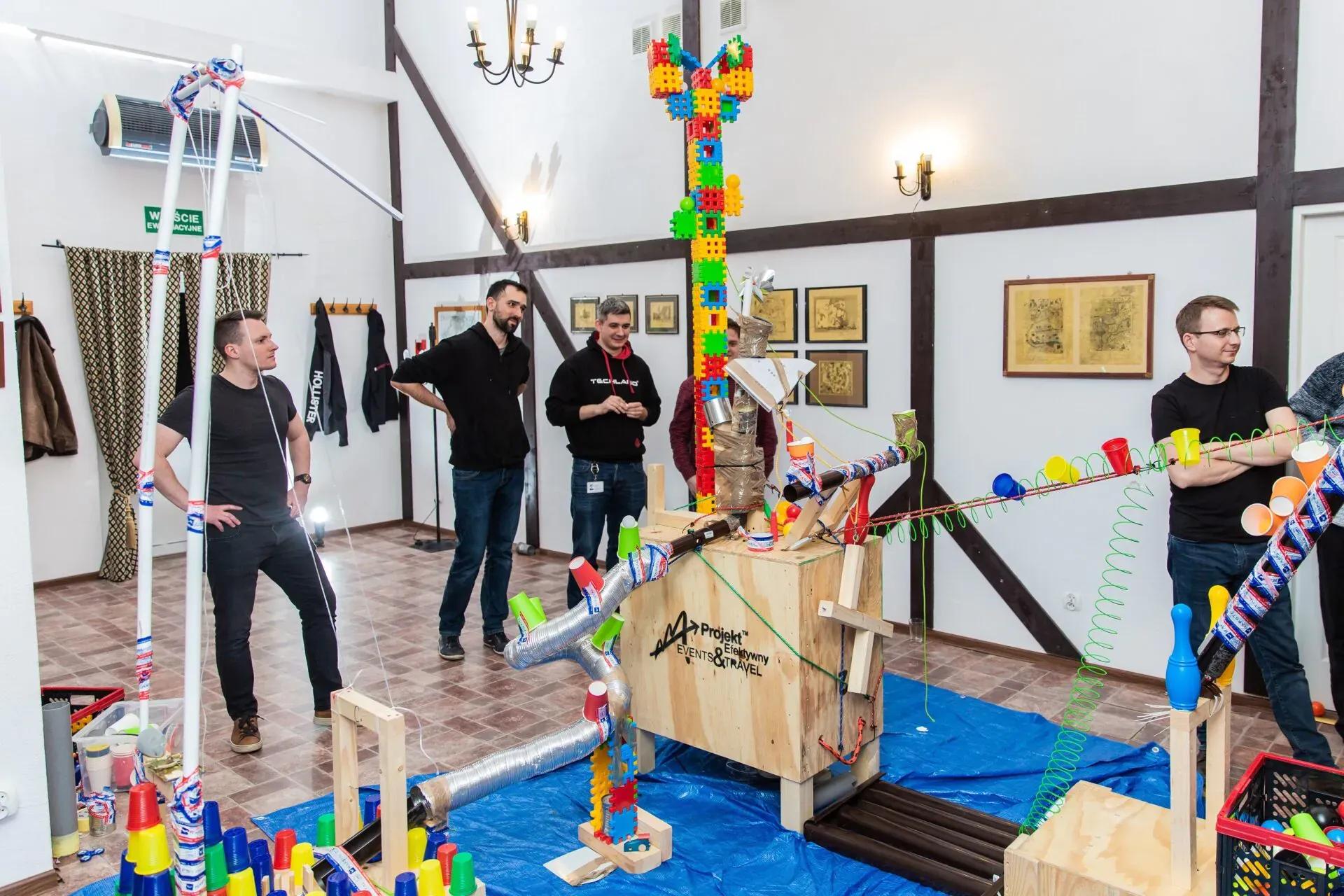
The Rube Goldberg Machine solves a specific problem: silos
Most organisations don't struggle with engagement within individual teams. People work hard, know their responsibilities, and deliver results. The breakdown happens at the interface — where marketing hands a brief to sales, where IT ships what product designed, where operations fulfils what the business promised.
The Rube Goldberg Machine is one of the very few corporate team building formats that physically simulates this problem. And solves it through experience, not a slide deck.
Interdependence becomes visible
In day-to-day work, departments rarely see directly how their decisions affect others. Here, that dependency is physical and immediate. A module that doesn't fit its neighbour stops the entire machine. This simple dynamic has a surprisingly strong impact on team awareness — one that stays long after the event.
Cross-team communication under controlled conditions
The build requires ongoing technical alignment between groups — but those negotiations are exactly the same as business negotiations: who owns the interface, who adapts, who defines the standard. Observing how your teams handle this without an external arbiter is rare and genuinely valuable information for leadership.
A finale that sticks
Most company retreats end with dinner. The Rube Goldberg Machine ends with a moment — physical, shared, and unambiguous. The machine either fires or it doesn't. That clarity creates a memory teams reference months later.
When does the Rube Goldberg Machine make most sense?
When your company is scaling fast and teams are losing sight of each other's work
Rapid growth naturally creates silos. This format works particularly well at the stage when "everyone used to know each other" no longer applies and collaboration needs to be actively rebuilt.
When merging teams after a restructure or acquisition
New organisational structures create new interfaces between people. The Rube Goldberg Machine helps teams quickly build practical understanding of who relies on whom — and what that should look like.
As part of a conference or project management training This format works brilliantly as a hands-on illustration of concepts like dependency management, critical path, ownership, and cross-functional interfaces. It fits as both an energising icebreaker and a deeper workshop module.
See how we integrate it into corporate conferences →
For tech and product teams
Software teams, IT departments, and product organisations immediately grasp the metaphor: modules, interfaces, compatibility, integration testing. It's one of the few formats that lands authentically with engineers without feeling forced or generic.
When you want WOW with substance
The Grand Finale is spectacular — but it's not the point. It's the only format where the visual impact and the organisational insight are fully synchronised.
Frequently asked questions — Rube Goldberg Machine
How is the Rube Goldberg Machine different from other team building workshops?
How is the Rube Goldberg Machine different from other team building workshops?
Most team building formats create competition between groups, where one team wins and others lose. The Rube Goldberg Machine is built on a different principle: every team must succeed simultaneously, because only then does the machine fire. It's a simulation of real cross-departmental interdependence — not a contest. The effect lasts longer too: participants don't remember who was fastest, they remember the moment the whole thing worked.
How much space is needed to run this event?
How much space is needed to run this event?
The format works in enclosed spaces. For 30–50 participants, a standard large conference room or hotel ballroom is sufficient. For 100+ people, we recommend a dedicated event space or exhibition hall. Every quote we provide includes minimum space requirements based on group size.
Will this work for experienced teams who've "done everything before"?
Will this work for experienced teams who've "done everything before"?
It's actually one of the better choices for mature, high-performing teams. The Rube Goldberg Machine isn't about breaking the ice — it's about building something together under conditions of uncertainty and time pressure. Experienced teams often discover new limitations and new strengths through this format, because it surfaces things that are invisible in day-to-day work.
Can we use the Rube Goldberg Machine as part of a larger conference or offsite?
Can we use the Rube Goldberg Machine as part of a larger conference or offsite?
Yes — this is one of the most common setups. The activity works well as part of a company retreat, as a workshop block following a plenary session, or as a standalone afternoon programme. We adapt the duration and complexity of the construction to fit your event agenda.
Do participants need technical or engineering skills?
Do participants need technical or engineering skills?
No. The materials are selected so that everyone can participate fully, regardless of manual dexterity or technical background. The core skills the format exercises — communication, coordination, collective decision-making — are equally accessible to every team. Our facilitators ensure no one ends up on the sidelines.
How much does the Rube Goldberg Machine cost for my team?
How much does the Rube Goldberg Machine cost for my team?
Pricing depends on group size, location, and scope — whether you need the activity alone or a full event package including hotel and catering. The base price for 30 people is 8,500 PLN, with 160 PLN per additional participant. We provide individual quotes after a short brief — no commitment required.
Can the Grand Finale be customised for a specific company message or brand moment?
Can the Grand Finale be customised for a specific company message or brand moment?
Yes. The final mechanism can be designed to reveal your company logo, launch a product name, unfurl a banner with a new campaign slogan, or create a shareable visual moment for internal comms or social media. This is a popular option for company anniversaries, product launches, and branded corporate events.
Do you handle full event logistics, not just the activity?
Do you handle full event logistics, not just the activity?
Yes — that's our standard model. We can deliver the Rube Goldberg Machine at a venue you've already booked, or we can propose a full package: hotel, transport, catering, and the activity as the centrepiece. One partner, one invoice, one project manager responsible for everything.