HOW IT WORKS
Part I — Practical Training (approx. 90 min)
Teams rotate through training stations led by active paramedic instructors:
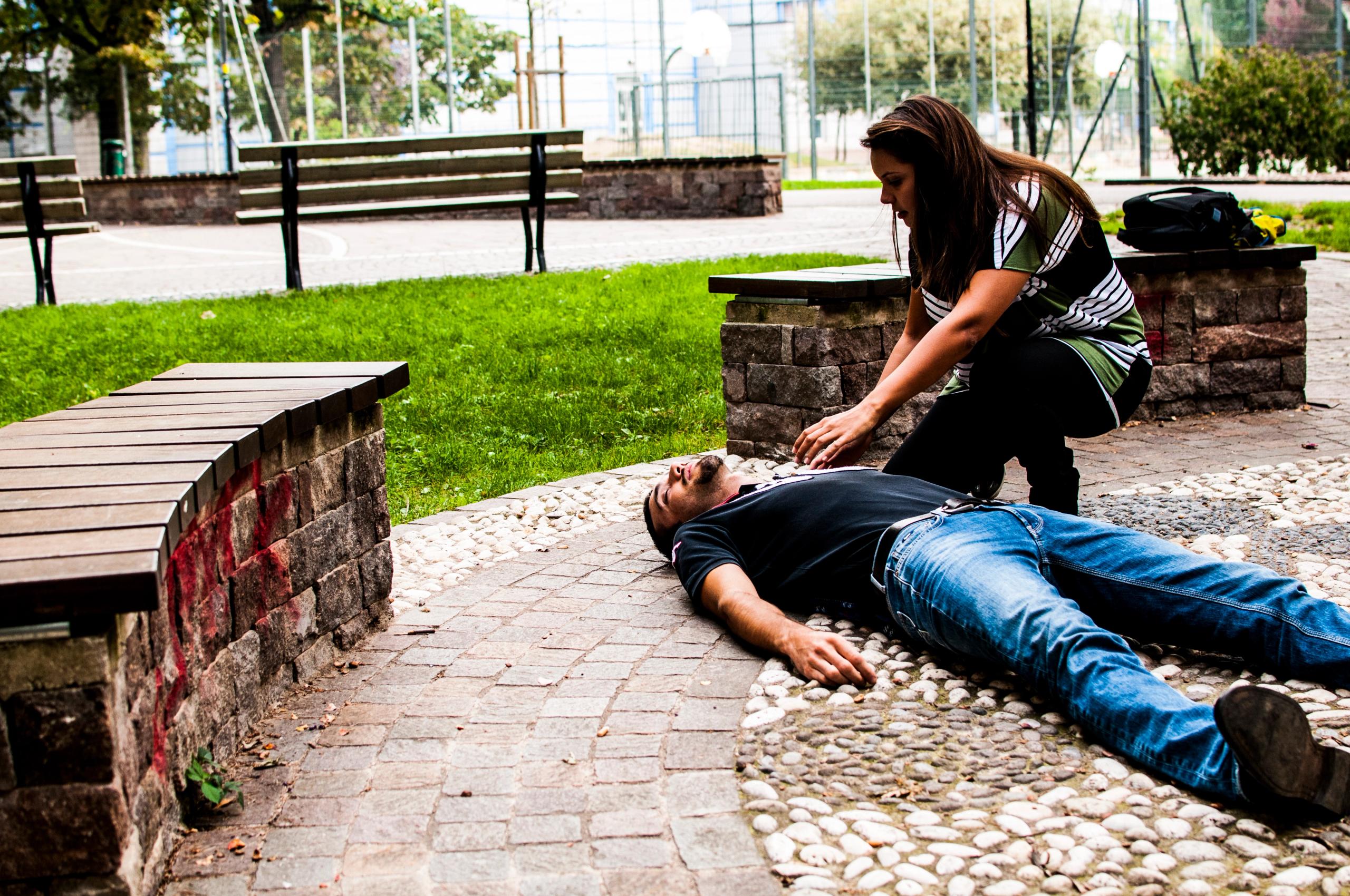
Recovery position — BLS algorithm step by step: how to manage an unconscious breathing person and place them in the recovery position.
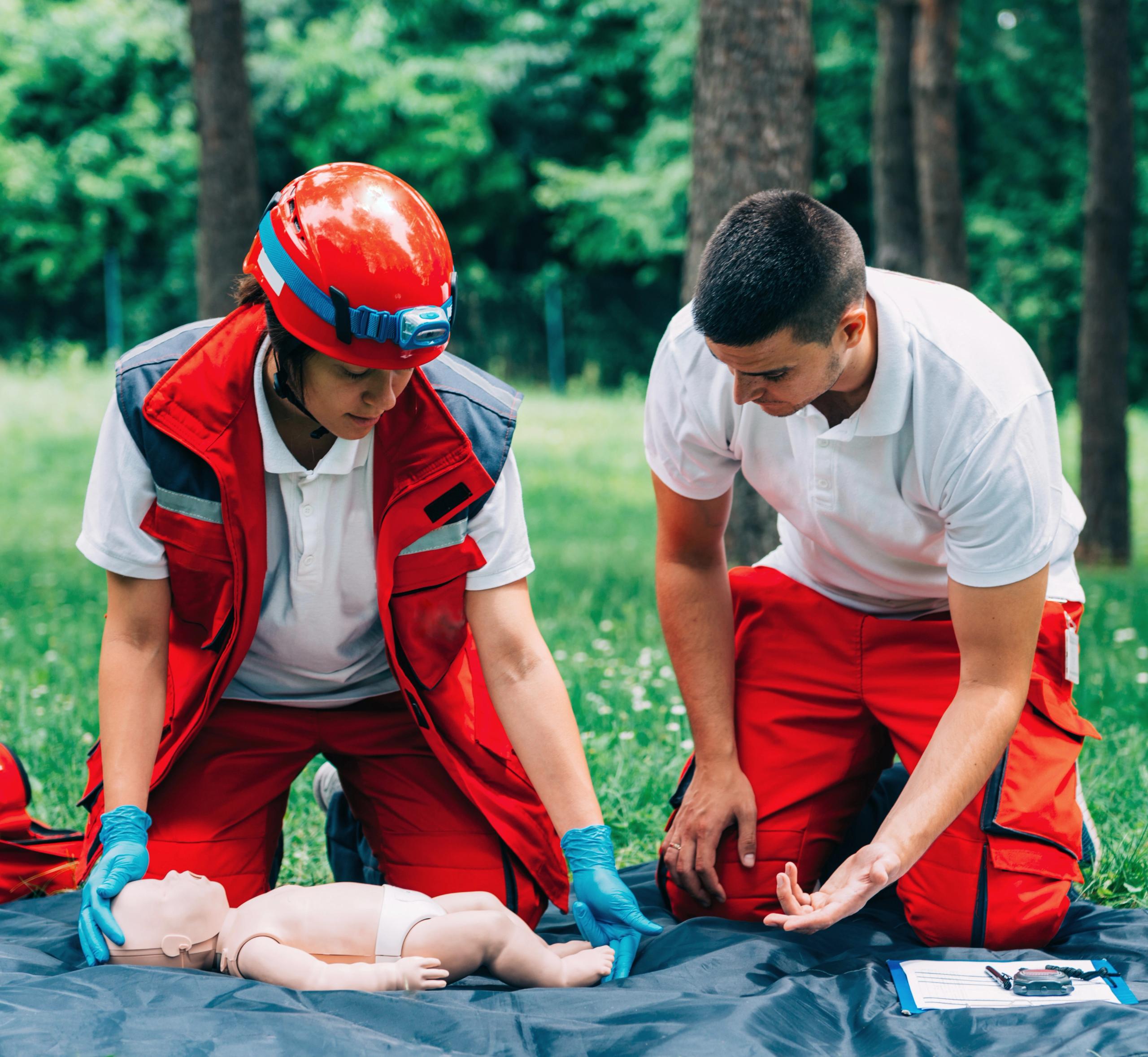
CPR and defibrillation — resuscitation training on adult manikins with QCPR app (real-time feedback on compression quality) + AED defibrillator operation on training devices.
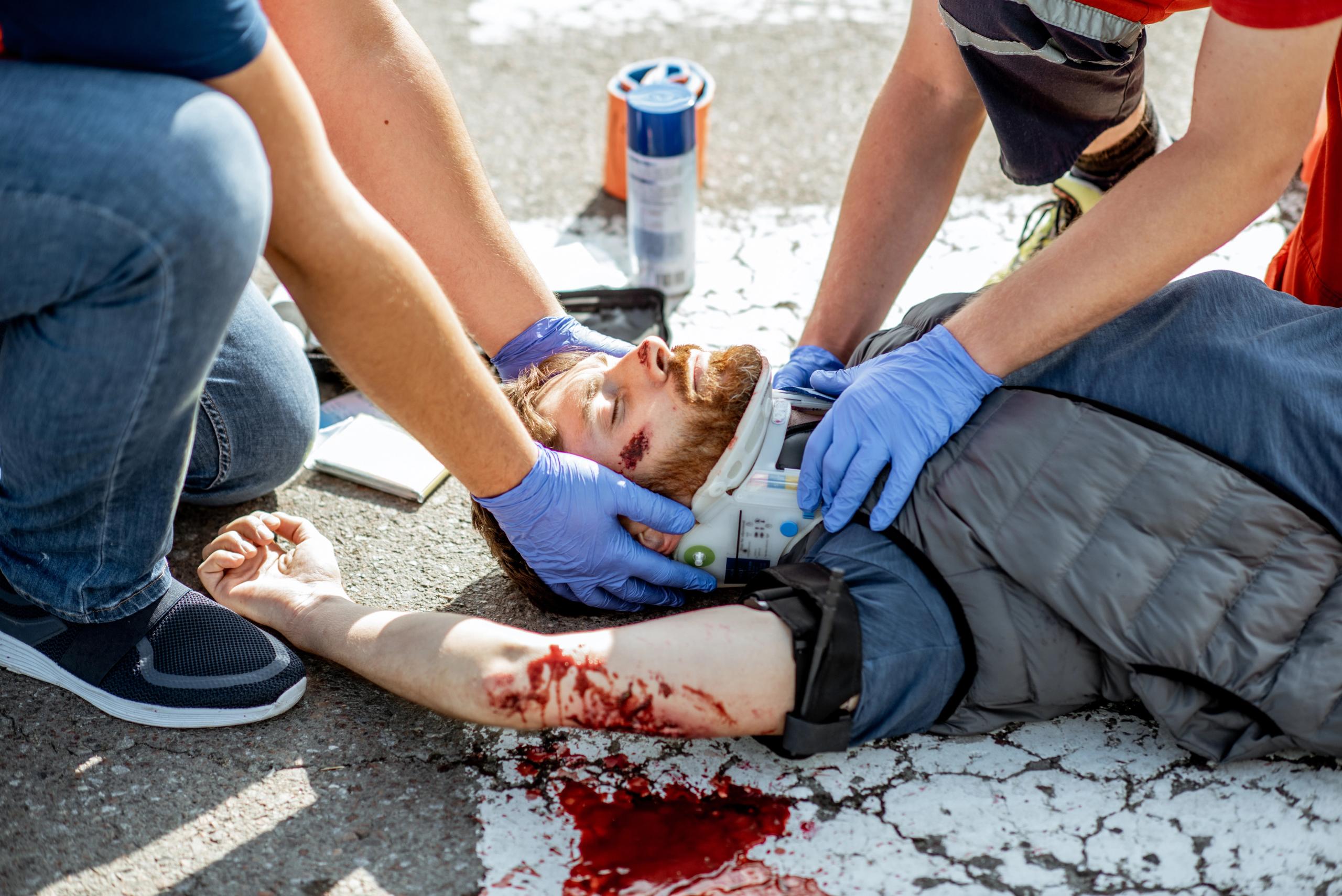
Haemorrhage control and trauma — techniques for stopping bleeding, wound dressing and bandaging, tourniquet application.
Choking — responding to choking in adults and infants, practice using the Act Fast choking vest worn by the instructor.
Part II — Rescue Game with Simulations (approx. 90 min)
Teams rotate through simulation stations with actors and professional medical make-up. Example stations:
Sudden cardiac arrest — the team enters a room where the "casualty" requires immediate resuscitation. Every second of delay costs the team points.
Severed hand — a worker has cut off their hand with a saw. Exercise uses a theatrical prosthetic limb, stage blood and tourniquet application.
Road traffic accident — a casualty trapped in a smoke-filled car. The team must extract them and provide first aid.
Fall from height — casualty with an open leg fracture (specialist wound prosthetic). Participants may cut clothing to access the injury.
Gunshot or stab wound — casualty shot in the chest or stabbed with a knife. Theatrical make-up with a chest wound prop.
Choking infant — an infant has choked and the mother is having a panic attack. Two casualties to manage simultaneously.
Electrocution — casualty being electrocuted in real time (special effects), with a burn wound prosthetic and full set design.
Car fire — participants learn how to respond to a vehicle fire and extinguish a burning engine compartment using fire extinguishers on a training rig.
Smoke-filled room — extracting a casualty from a smoke-filled space (smoke tent with foam props simulating room objects).
Scoring and certificates
The gamification system scores: medical accuracy, reaction time, team communication and personal safety awareness. Every participant can receive a personal certificate confirming practical first aid competencies upon completion.
WHY IT WORKS
1. Knowledge that actually sticks — and can save a life Traditional first aid courses are passive and quickly forgotten. Mission: Life engages emotions — when a participant physically compresses a manikin's chest to prevent their team losing points, they create lasting memory traces. That knowledge stays with them not just at the office — but on holiday, commuting, at home.
2. A natural stress test for the team Simulated life-threatening situations reveal true character. Natural leaders emerge. You see who can delegate (calling the ambulance, fetching the first aid kit) and who performs best in operational roles. A powerful lesson in stress management and communication under time pressure — without a single flipchart exercise.
3. A fully inclusive format Participants who cannot perform physical exertion (CPR on a manikin) are assigned equally important roles — coordinators, people calling emergency services, psychological support for casualties. No one is excluded; everyone contributes real value to the team.
WHEN TO BOOK IT
Company retreat with an outdoor programme — an adrenaline-filled field activity in a forest, by a lake or on hotel grounds. One of the most memorable formats for a company retreat in Poland for teams that have "seen everything".
Conference or training event — an unexpected, energising block in the middle of a content-heavy day. Breaks through presentation fatigue and stays in the memory long after the event. A natural fit within conference and meeting management.
Team building with CSR values — first aid training demonstrates that the company invests in its people's safety beyond working hours. A strong fit within broader team building programmes.
Corporate family picnic — a dedicated "Junior and Senior Rescue Zone" where families learn first aid together. An outstanding activity for outdoor corporate events.
See what our customers ask about most frequently
How does Mission: Life differ from a standard first aid course for companies?
How does Mission: Life differ from a standard first aid course for companies?
Mission: Life is a rescue game with gamification and realistic simulations — not a first aid course. A standard corporate first aid training is a passive lecture that most participants forget within a week. Mission: Life engages emotions, team competition and professional actors — knowledge gained through stress and action stays for years.
Is this a standard mandatory workplace first aid training?
Is this a standard mandatory workplace first aid training?
No — Mission: Life is a rescue game with gamification, realistic simulations and professional actors. It is voluntary, engaging and genuinely emotional. Participants regularly request a repeat.
How long does Mission: Life last?
How long does Mission: Life last?
We offer two programmes: 3.5 hours (3 teams, 3 training exercises + 4 simulations) and 4 hours (4 teams, 4 training exercises + 4 simulations). We recommend the right format based on group size and available time.
Is the game too intense or distressing for some participants?
Is the game too intense or distressing for some participants?
The realism is controlled and calibrated to the group. Actors respond to participants' stress levels, and every station is briefed by a paramedic beforehand. The format is designed to teach composure — not cause trauma.
Where can Mission: Life take place?
Where can Mission: Life take place?
Anywhere — on hotel grounds, in office corridors, in a conference room, at a company picnic. We bring all equipment and configure the space for the scenario.
How much does Mission: Life cost for companies?
How much does Mission: Life cost for companies?
Pricing depends on group size, selected modules and location. We provide individual quotes after a short brief — fill in the contact form or write to us and we'll get back to you within 24 hours.
Who leads the simulations?
Who leads the simulations?
Exclusively active, practising paramedics (emergency medical services, fire rescue). We do not use instructors without active clinical practice — the knowledge is current and grounded in real emergency experience.
Do participants receive certificates?
Do participants receive certificates?
Yes — every participant can receive a personal certificate confirming practical first aid competencies upon completing the scenario.